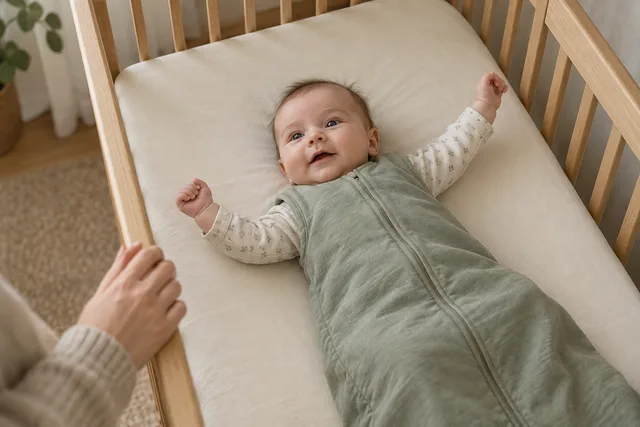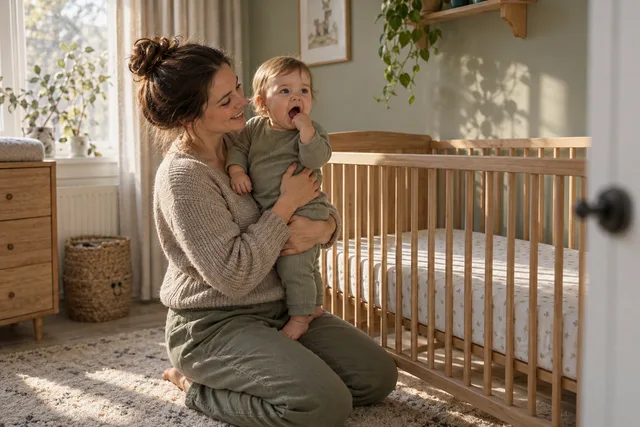


A wake window usually means the time between waking and falling asleep again. It can describe your day, but a table cannot determine your baby’s next sleep to the minute. Observe behaviour as well as time.
Sources: Paruthi et al. (2016) · BIÖG
A wake window sits between two sleeps
Observe → offer a calm moment → notice the response
What is being measured?
For your own notes, count from observed waking to observed sleep onset. Time spent helping your baby settle is still within that interval. A chart that stops at the start of a bedtime routine uses a different definition.
Consistency matters more than perfect precision. Mark uncertainty, such as not knowing exactly when your baby fell asleep in the stroller.
Why we do not prescribe minutes
Recommendations for total sleep do not automatically prescribe its distribution. An average from other babies cannot calculate your baby’s next suitable sleep time.
Our source set does not provide a binding age-by-age wake-window schedule. That does not make awake time irrelevant; it limits how confidently a table can be presented as a rule. The illustration therefore shows a sequence without targets.
Sources: Paruthi et al. (2016) · BIÖG
Consider timing and behaviour together
Alongside the time, note what you observe: becoming quieter, turning away, yawning or seeming unsettled. These observations help you get to know your baby, but none exclusively identifies a need for sleep.
Instead of “sleep must happen now”, ask “might a calmer setting help?”. If it does not, neither your notes nor your judgement have failed.
Sources: BABYFREUNDLICH
Digital predictions are estimates too
A time calculated from past entries depends on what was recorded. A missed nap changes the apparent wake window. New circumstances cannot reliably be predicted from old data.
Use an estimate as a reminder to observe. It should not override tiredness, hunger or individual medical advice.
When to seek support
Seek support for persistently difficult settling, pain, feeding problems or unusual sleepiness. A more precise timer does not replace assessment of symptoms.
Common questions
Does settling time count?
In our definition, yes: the interval ends at observed sleep onset. Other charts may count differently.
Can Livona predict the next sleep with certainty?
No. The Premium sleep clock estimates timing from recorded wake periods. Missing entries and changing circumstances limit it.
Sources & context
The linked sources support the marked statements. Arithmetic examples and everyday suggestions offer orientation. Sources last accessed on 20 September 2026.
- Paruthi et al. (2016): AASM-Konsens zur Schlafdauer
Professional guidance; see the linked publication for context.
- BIÖG: Das Wichtigste zum Schlaf im ersten Lebensjahr
German-language health resource; local guidance may differ.
- BABYFREUNDLICH: Unruhige Nächte (2025)
German-language health resource; local guidance may differ.
- DGSM: Schlafstörungen bei Säuglingen, Kleinkindern, Kindern und Jugendlichen
German-language health resource; local guidance may differ.
- NHS: Dehydration
UK public-health guidance.
This guide was created with AI assistance and has not been medically reviewed. More about authorship and our approach.