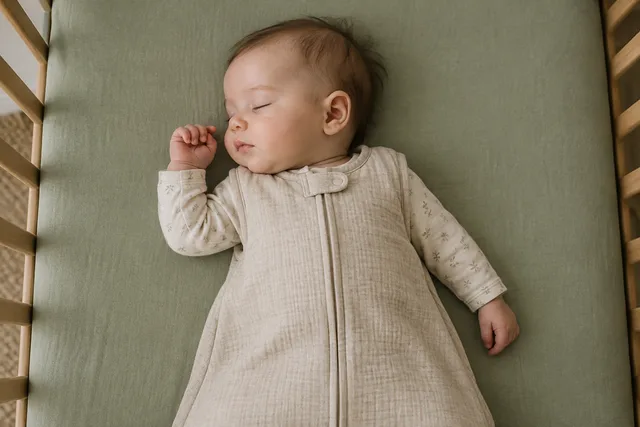


At six months, naps still count towards total sleep. The AASM consensus recommends 12–16 hours per 24 hours, including naps, for ages four to twelve months. This is an age-group recommendation, not a fixed timetable.
Sources: Paruthi et al. (2016) · BIÖG
Two distributions, the same total
- Example A
- 10 + 3 = 13 hNight sleep + daytime sleep
- Example B
- 11 + 2 = 13 hNight sleep + daytime sleep
What a schedule can show
A schedule can help you distinguish parts of the day. It cannot tell you exactly when your baby will be tired today. Looking at several days is more useful than matching a single example, especially when daily life changes.
Choose a practical question: has the last nap shifted later, or does a “bad night” mean more interruptions? Different questions need different observations.
Sources: BIÖG
Put the full 24 hours together
Add actual sleep during the day and night. Time between bedtime and getting up may include periods awake. Our examples show that ten hours at night plus three during the day and eleven plus two both total 13 hours. The distributions are invented.
Sources: Paruthi et al. (2016)
Include naps and feeds
Records help describe your day. They are not a reason to ignore hunger or keep a clearly tired baby awake until a scheduled time. Starting solid foods does not promise longer nights either.
Observe one small change
If you want to try a calmer evening transition, first note what you changed. Keep the observation manageable. One easier evening afterwards does not prove that the change caused it.
A useful note might read: “Dimmed lights earlier; falling asleep was similar to yesterday.” Unchanged days are information too. You do not need to turn this into a daily analysis project.
When to seek support
Seek medical help if your baby seems unwell, feeds poorly or is unusually difficult to wake. Ongoing parental exhaustion also deserves support. For breathing difficulty or unresponsiveness, call your local emergency number.
Common questions
Must a six-month-old sleep through the night?
No. Night waking can continue; reaching six months does not create a new sleep requirement.
Is there a required number of naps?
The AASM duration range does not prescribe a nap count.
Sources & context
The linked sources support the marked statements. Arithmetic examples and everyday suggestions offer orientation. Sources last accessed on 20 September 2026.
- Paruthi et al. (2016): AASM-Konsens zur Schlafdauer
Professional guidance; see the linked publication for context.
- BIÖG: Das Wichtigste zum Schlaf im ersten Lebensjahr
German-language health resource; local guidance may differ.
- NHS: Helping your baby to sleep
UK public-health guidance.
- NHS: Your baby’s first solid foods
UK public-health guidance.
- DGSM: Schlafstörungen bei Säuglingen, Kleinkindern, Kindern und Jugendlichen
German-language health resource; local guidance may differ.
- NHS: Dehydration
UK public-health guidance.
This guide was created with AI assistance and has not been medically reviewed. More about authorship and our approach.